Verite · Shoot In Panama
A production house with MTV, CBS, and NBC credits. One primary domain returning a 404.
El Problema
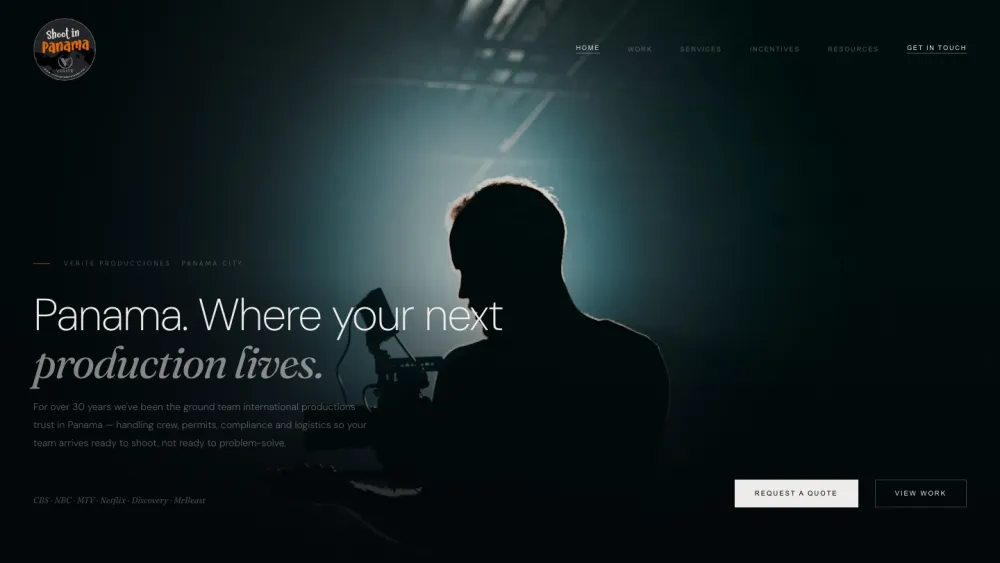
Verite Producciones operates Shoot In Panama and holds production credits with MTV's The Challenge, CBS's The Amazing Race, NBC's Deal or No Deal Island, MrBeast, and the OEA. They are a member of the International Quorum of Motion Picture Producers.
Their primary domain returned a 404.
This is the sharpest illustration of a pattern that runs through the entire Panamanian services economy: the reputational asset and the digital asset were completely disconnected, and the disconnect was invisible from the inside. The phone kept ringing from existing relationships, so nothing appeared to be broken.
The specific findings:
- veriteproducciones.net returning 404. The holding company's primary domain was dead. Google could not index it. Every Spanish-language search for audiovisual production in Panama resolved to competitors — not because competitors ranked better, but because Verite had nothing to rank.
- Meta description of 521 characters on the Shoot In Panama domain. The visible SERP limit is roughly 155. The description was written for nobody — too long for a search engine, invisible to a human.
- No semantic separation between two distinct business channels. Verite Producciones serves Spanish-language corporate and local production. Shoot In Panama serves international executive producers scouting Latin American locations. Two audiences, two languages, two buying processes, two entirely different search vocabularies — collapsed into an undifferentiated digital presence.
- Client credits unstructured. The MTV, CBS, NBC, and MrBeast credits — the single most persuasive asset the company owns — existed as flat text with no entity relationships. To a machine, "The Amazing Race" was a string, not a production credit connected to a production company.
- Legacy Oracle-based hosting with no export path. Static brochure architecture on infrastructure that could not be modified, extended, or instrumented.
El Costo
The buyer here is a producer in Los Angeles or Madrid deciding where to shoot. That decision starts with a search — in English — and increasingly with a question to a language model: who handles production services in Panama, and have they worked with US networks?
Verite had the strongest possible answer to that question and no mechanism to deliver it.
The asymmetry in this vertical is unusually steep. Production is a relationship business with a discovery bottleneck: the work comes from referral and repeat business, so the digital gap never causes visible pain — it causes invisible non-events. The producer who never found them never called, and their absence generates no signal.
A dead domain and a 521-character meta description are not marketing problems. They are the difference between being on a shortlist that gets written in another hemisphere and never entering the conversation.
La Intervención
Two-domain architecture rebuilt on vanilla HTML/CSS/JS, deployed to Cloudflare Pages via GitHub — no framework overhead on a site whose job is speed and legibility.
Semantic channel separation. Rather than one site attempting to serve both audiences, each domain was given a distinct semantic identity: Verite Producciones as the Spanish-language holding and corporate production entity, Shoot In Panama as the English-language international production services entity, with a declared structural relationship between them. This is not a translation exercise. It is the recognition that an executive producer in Madrid and a corporate client in Panama City are running two different searches and need two different machine-readable answers.

Credit structuring. Network credits encoded as structured production relationships rather than decorative text, with NDA-protected work handled explicitly — confidential engagements marked as such rather than omitted, which turns a limitation into a signal of the tier of work involved.
Full SPA architecture across Home, Work, Services, Resources, and Contact, with hash-based routing and browser history support. The Resources layer carries six operational documents — filming permit guidance, location release templates, rate cards, location briefs, insurance checklists, crew and talent guides.
That Resources layer is the asymmetric move. An international producer evaluating a Panamanian fixer is managing risk, not shopping. Publishing the operational instruments of the job converts an unknown vendor into an evident professional before a single conversation happens — and competitors who treat these documents as proprietary have no answer to it.
Migration and infrastructure. Full technical handoff from the legacy provider — EPP transfer code, DNS zone records, complete file export — onto Cloudflare with a clean security header implementation.
El Resultado
Two domains, two audiences, two machine-readable identities, one declared corporate relationship.
The production credits are now structured data rather than a wall of network logos. The operational documents that international producers actually need are published rather than gated. The dead domain is alive and indexable.
The full argument for why niche service businesses should split domains semantically rather than translating one site is developed in The Architecture newsletter.